
Living With Purpose Without Trying to Control the Outcome
What does it actually mean to live intentionally? The phrase is used so often that it can sound like another way of saying we should have goals, make plans, or know exactly where our lives are headed. Intentional living is deeper than that. It is about becoming conscious of how we participate in our own lives and understanding why we make the choices we make.
Living intentionally does not require having everything figured out. It requires awareness. We can have plans and still change direction. We can have goals and discover something different along the way. We can know what we want without knowing exactly how we are going to get there. The intention is found in how consciously we participate in the process.
Many of us spend portions of our lives operating from routines, beliefs, reactions, and expectations that we rarely stop to examine. Some were taught to us. Others developed through experience. Eventually, what is familiar can begin to feel like who we are, even when it no longer reflects who we have become. Intentional living creates room to examine those patterns and decide what still belongs in our lives.
Intention and Control Are Not the Same Thing
One of the most important distinctions in intentional living is the difference between intention and control. We can decide how we want to show up in the world. We can choose our values, establish boundaries, pursue relationships, build businesses, create art, change habits, and determine where we want to place our energy. Those are decisions concerning our own participation.
Control begins when our desired outcome depends on someone or something else behaving according to the plan we have already created. We may enter a relationship with the intention of building something meaningful, for example, while the other person still has the freedom to decide what they want. We may pursue a career opportunity with purpose and preparation without being able to guarantee that we will receive it. We may plant a seed, care for the soil, provide water and sunlight, and still recognize that growth has its own process.
That distinction matters because intention allows us to remain responsible for ourselves without assuming responsibility for everything surrounding us. There is freedom in recognizing what belongs to us and what does not.
Intentional living therefore isn't about manipulating life until everything turns out exactly as planned. It is about choosing how we participate even when we cannot control the outcome.
Moving Beyond Autopilot
Human beings naturally develop routines. Routine itself is not a problem; it allows us to move through everyday life without having to consciously relearn every action. The challenge comes when we stop examining whether our familiar patterns continue to serve us.
We can remain in relationships because they are familiar. We can continue habits because we have repeated them for years. We can inherit beliefs about success, love, family, spirituality, money, or even ourselves without ever asking where those beliefs originated. Something can become normal simply because it has been repeated long enough.
Living intentionally interrupts that autopilot. It gives us permission to ask why.
Why do I respond this way? Why am I continuing to participate in this situation? Is this something I genuinely believe, or something I learned to believe? Does the way I spend my time reflect what I say is important to me? Am I choosing this because it aligns with who I am, or because it is what I have always done?
Those questions are not necessarily demands to change everything. Awareness may actually confirm that some of our existing choices still fit us beautifully. The difference is that we are no longer participating unconsciously. We have examined the choice and decided that it remains ours.
Purpose Exists in Ordinary Life
When people talk about living with purpose, the word purpose can become unnecessarily intimidating. We often associate it with discovering one enormous calling that explains our entire existence. Purpose can certainly appear through a career, business, creative work, service, family, or something we feel deeply called to accomplish. It can also exist in much smaller decisions.
There can be intention in how we communicate with another person. There can be purpose in deciding not to participate in unnecessary conflict. Rest can be intentional. So can creating something, spending time with family, changing an unhealthy pattern, setting a boundary, learning something new, or simply being fully present in a moment we would normally rush through.
Intentional living does not always require doing more. Sometimes it requires understanding why we are doing what we already do.
This is also where our priorities become visible. We may say something matters deeply to us, while consistently giving our time and energy to everything surrounding it. Looking at how we actually live can tell us more about our priorities than looking at what we say our priorities are. That realization is not about judgment. It gives us information. Once we have the information, we can decide whether our actions and values still align.
Growth Can Change Our Intentions
Intentional living also leaves room for change. What was right for us several years ago may not fit who we are today. Experience gives us new information. Growth changes our perspective. Healing can change our boundaries. New responsibilities can change our priorities, and greater self-awareness can change what we are willing to accept or participate in.
Changing direction does not automatically mean the previous direction was a mistake. Sometimes an experience serves its purpose by teaching us what we needed to understand at that particular point in our lives. We can appreciate what something taught us without remaining attached to it after it has stopped aligning with who we are becoming.
There is a difference between quitting because something becomes uncomfortable and recognizing that something has completed its purpose in our lives. Intentional living asks us to develop enough self-awareness to examine that difference for ourselves.
It also means allowing other people that same freedom. If we expect room to grow, reconsider, learn, and change direction, we have to recognize that other people are capable of doing the same. Their direction may not always match ours. We can care about someone without controlling their path, and we can honor our own path without requiring them to understand every decision we make.
Living Intentionally in the Present
Perhaps the greatest misconception about intentional living is that it is primarily about the future. Goals matter. Planning matters. Vision matters. Yet the only place we can actually practice intention is in the present.
We cannot make yesterday's choices again, and tomorrow's decisions have not arrived. What we have is the choice directly in front of us. The question becomes whether we are present enough to recognize that we are making one.
That can mean asking ourselves whether our current actions are moving us toward what we say we value. It can mean recognizing when fear is making a decision for us, when familiarity is keeping us somewhere we no longer belong, or when we are so focused on reaching the next destination that we are absent from the life happening now.
Living intentionally is not about creating a perfect life. It is about becoming an active participant in the life we already have.
There will still be unexpected circumstances. People will make choices we cannot control. Plans will change. Opportunities will appear that we never anticipated, and some things we thought we wanted may turn out not to be what we needed at all. Intention does not remove uncertainty from life. It changes how consciously we move through it.
So perhaps the question is not simply, “What do I want my life to become?”
A more immediate question may be:
“Am I consciously participating in the life I am living right now?”
That is where intentional living begins.
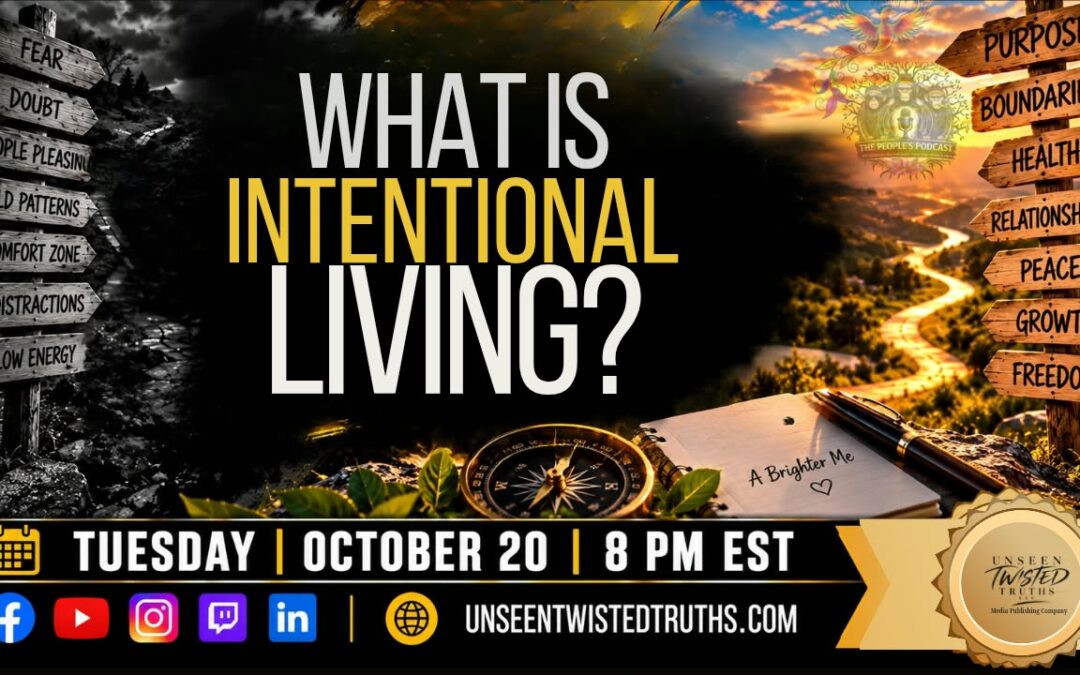
Join Universe Badger and Moon Tortoise on The People’s Podcast as we explore “What Is Intentional Living?” and open the conversation about purpose, awareness, personal choice, control, growth, and what it means to consciously participate in our own lives.
Have you been living intentionally, or have you discovered areas of your life that have been running on autopilot?
Let’s have a good conversation.
Go check out our website at UnseenTwistedTruths.com. We’re the ears that listen, where your opinion matters and so does your story—because you matter.
Asè.