
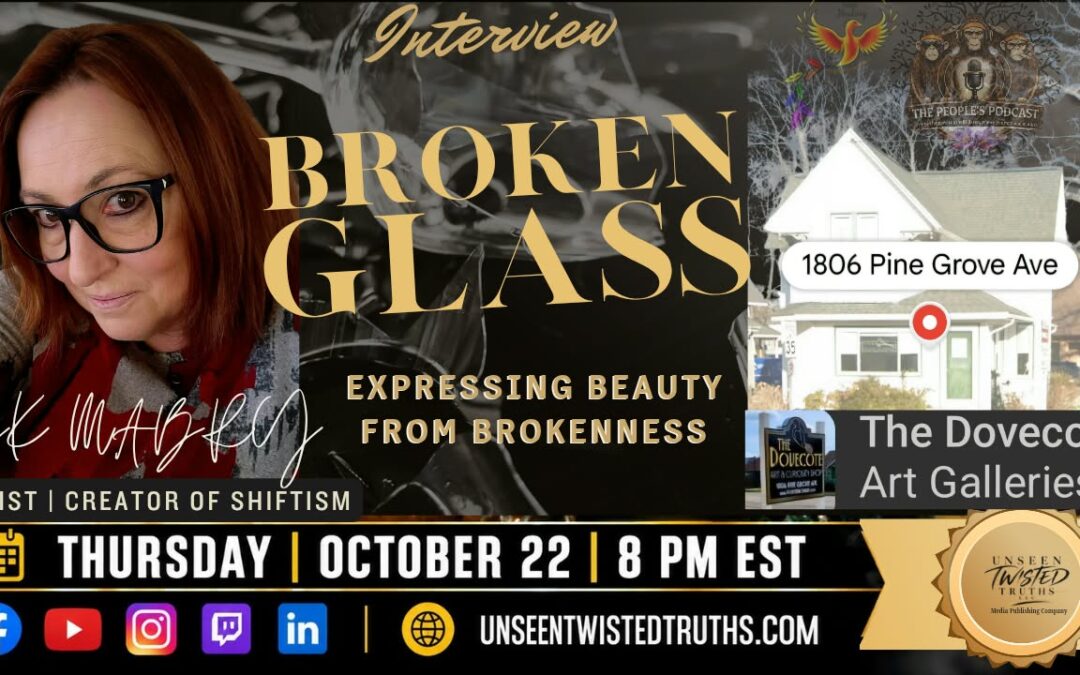
SK Mabry, Shiftism, and How a Change in Perspective Can Change What We See
What happens when something most people would consider broken becomes the very tool used to create something new? That question is at the center of our upcoming conversation with Port Huron artist SK Mabry, creator of the artistic style known as Shiftism and owner of Art of SK Mabry, LLC, DBA The Dovecote Art & Curiosity Shop. Mabry’s work provides an interesting entry point into a much broader conversation about art, perception, interpretation, healing, and the meanings we attach to what we see.
Mabry is an eclectic artist whose work contains elements of expressionism and impressionism, yet one of the most distinctive aspects of her creative process is not simply what she paints. It is what she sometimes paints with. Rather than relying exclusively on conventional brushes, Mabry uses selected pieces of broken glass or pottery as tools in her painting process. On her official artist page, she connects this technique to the idea of expressing beauty from brokenness, the layers of life, and the shifting realities we encounter as we move through our experiences.
That process raises an interesting question about the word broken itself. When a glass object shatters, our immediate reaction may be to view it as damaged or useless because it can no longer function in the way it originally did. Yet in Mabry’s hands, that same material can acquire another purpose. The break does not disappear, nor does the glass have to be restored to its previous form before it becomes valuable again. Its altered condition becomes part of the creative process.
That distinction is part of what makes Mabry’s work especially fitting for our Thursday conversation, “Broken Glass: Expressing Beauty From Brokenness.” The episode begins with her art, yet the larger discussion asks what can happen when we reconsider the meaning we have assigned to something—or someone—we have already decided is broken.
The Art of Shifting Perspective
Mabry calls the artistic style she created Shiftism, a name that naturally invites questions about movement and perspective. Her artist statement offers insight into a process that embraces changing realities and personal interpretation. Rather than prescribing exactly what viewers are supposed to see when they encounter unexpected images or forms within a composition, Mabry allows the viewer to experience the work individually.
That approach highlights one of the most fascinating aspects of perception: two people can look at the same object and experience it differently. One viewer may be drawn immediately to a particular shape while another barely notices it. A color that creates comfort for one person may remind someone else of grief, childhood, a relationship, or a place they once lived. The physical artwork can remain unchanged while the experience of viewing it varies dramatically.
This does not happen only with art. Human beings interpret the world through far more than eyesight. We bring memory, previous experiences, expectations, beliefs, emotional states, relationships, fears, knowledge, and personal history into the process of deciding what something means. We may believe we are simply responding to what is directly in front of us when, in reality, we are also responding to everything we brought with us when we arrived.
Consider how easily this happens between people. Silence may be interpreted as anger, even though the person is thinking. A boundary may be interpreted as rejection without understanding why the boundary exists. Confidence can be perceived as arrogance. Someone experiencing a difficult period may be labeled broken when they are struggling, grieving, healing, changing, or trying to understand what comes next. What we observe may be real; the interpretation we immediately attach to that observation is another matter entirely.
This is where a deeper look at perception becomes important. Learning additional information can completely alter the meaning of something we have already seen. An object that appears insignificant may become priceless once we learn who gave it to its owner. A scar may look like damaged skin until we hear the story of survival connected to it. Something as ordinary as a person’s hair may appear to be simply a hairstyle to an observer while representing years of healing, identity, protection, personal growth, strength, and rebuilding trust within oneself to the person wearing it. The physical thing did not suddenly change when we learned the story. Our understanding of what we were seeing changed.
When Broken Does Not Mean Destroyed
The use of broken glass also creates an opportunity to examine how we talk about healing. We frequently use phrases such as “putting the pieces back together” or “getting back to who I was,” as though successful healing requires reconstructing ourselves into the exact configuration that existed before a difficult experience occurred. That may describe some experiences accurately, yet it does not describe all of them.
Some experiences change us permanently. Grief can change us. Relationships can change us. Becoming a parent can change us. Loss, success, failure, love, betrayal, education, aging, spiritual growth, and discovering things about ourselves that we previously did not understand can all alter the way we experience the world. Permanent change does not automatically mean permanent destruction.
That is what makes the broken-glass metaphor particularly useful. If shattered glass can become a tool in the creation of something new, then usefulness is not necessarily dependent upon returning something to its previous state. The original object may no longer exist in the same form, yet the material still exists and can participate in something entirely different.
Applied to people, that idea does not require romanticizing pain or pretending that harmful experiences are somehow beautiful simply because growth eventually followed them. Changing our perspective does not erase what happened, excuse another person’s actions, or require us to deny the reality of an experience. Instead, perspective can change our relationship with what happened. An experience once associated entirely with pain may eventually also represent endurance. An ending initially viewed as failure may later be understood as redirection. A characteristic someone once criticized may eventually become something we recognize as an important part of our identity.
In other words, seeing something differently does not rewrite its history. It can expand its meaning.
The Dovecote: Art, Curiosity, and Community in Port Huron
Mabry’s creative work has a physical home in Port Huron at The Dovecote Art & Curiosity Shop, operated through Art of SK Mabry, LLC. The Dovecote houses Mabry’s personal studio while also offering an eclectic environment that includes art, vintage items, antiques, collectibles, and curiosities.
Located at 1806 Pine Grove Avenue in Port Huron, Michigan, The Dovecote is recognizable as the big white house just south of the Blue Water Bridge entrance in the area described as the “Uptown Creative Arts District.” The setting feels particularly appropriate for an artist whose work encourages curiosity and individual interpretation. It is not simply a place to encounter finished artwork; it provides a physical setting for the broader creative identity Mabry has developed around her work.
Mabry’s artistic journey in its present form began in 2019 following decades of professional experience in the health and legal fields. Her artistic work and community involvement have since included juried exhibitions, abstract portraiture, community art, Art on the River, and participation in ArtPrize 2025. Her path is another reminder that creativity does not have to follow a predetermined timeline. An artistic identity can continue developing as a person’s experiences, interests, skills, and perspective evolve.
What Changes When We See Differently?
Perhaps the most compelling connection between Shiftism and the idea of broken glass is that both invite us to question whether our first interpretation must become our final one. Perspective can change when we gain information, when we hear another person’s story, when our emotional state changes, or simply when enough time has passed for us to look at an experience from another position.
Two people may even experience the same event and remember or interpret it differently. That does not automatically establish that one person is being dishonest. Human beings do not experience life like recording devices. Attention is selective, memories are constructed through individual experience, and meaning is influenced by context. We can occupy the same room without experiencing the same moment in precisely the same way.
Recognizing that reality does not mean every interpretation is equally accurate or that objective facts do not matter. It means there is value in distinguishing between what we know happened and what we believe it meant. That distinction can create room for curiosity before judgment, particularly when we are looking at another person’s life from the outside.
It can also change the way we look inward. A part of ourselves we once described as broken may look different after years of growth. We may eventually discover that we were wounded rather than ruined, inexperienced rather than incapable, changing rather than lost, or simply seeing ourselves through a perspective we no longer hold.
This is why Mabry’s use of broken glass becomes more than an interesting artistic technique. It provides a tangible way to examine what happens when something no longer fits its original definition. The glass is still fractured. Its history has not been erased. Yet its story does not necessarily have to end at the moment it broke.
Perhaps healing works similarly. There are times when healing means repairing what can be repaired. There are other times when healing means accepting that we cannot recreate what existed before and allowing ourselves to discover what can be created now.
That is the conversation we want to explore.
On Thursday, October 22 at 8 PM EST, Universe Badger and Moon Tortoise will sit down with SK Mabry on The People’s Podcast for “Broken Glass: Expressing Beauty From Brokenness.” We will talk with Mabry about her art, her unconventional creative process, the meaning of Shiftism, and what she sees when she looks at materials others may overlook. From there, the conversation will expand into perspective, identity, healing, transformation, and the stories we attach to ourselves and one another.
Because sometimes the most important change is not in the object we are looking at.
Sometimes it is in the person doing the looking.
Connect With SK Mabry and The Dovecote
Art of SK Mabry, LLC
DBA The Dovecote — Art & Curiosity Shop
1806 Pine Grove Avenue
Port Huron, Michigan 48060
Visit The Dovecote and Art of SK Mabry
Explore SK Mabry’s artwork and artist statement
Follow The Dovecote on Facebook
LIVE ON FACEBOOK , YOUTUBE , Twitch , & :LinkedIn
BROKEN GLASS: EXPRESSING BEAUTY FROM BROKENNESS
Thursday, October 22 | 8 PM EST
The People’s Podcast | Unseen Twisted Truths
We’re the ears that listen, where your opinion matters and so does your story because you matter.
Asè.