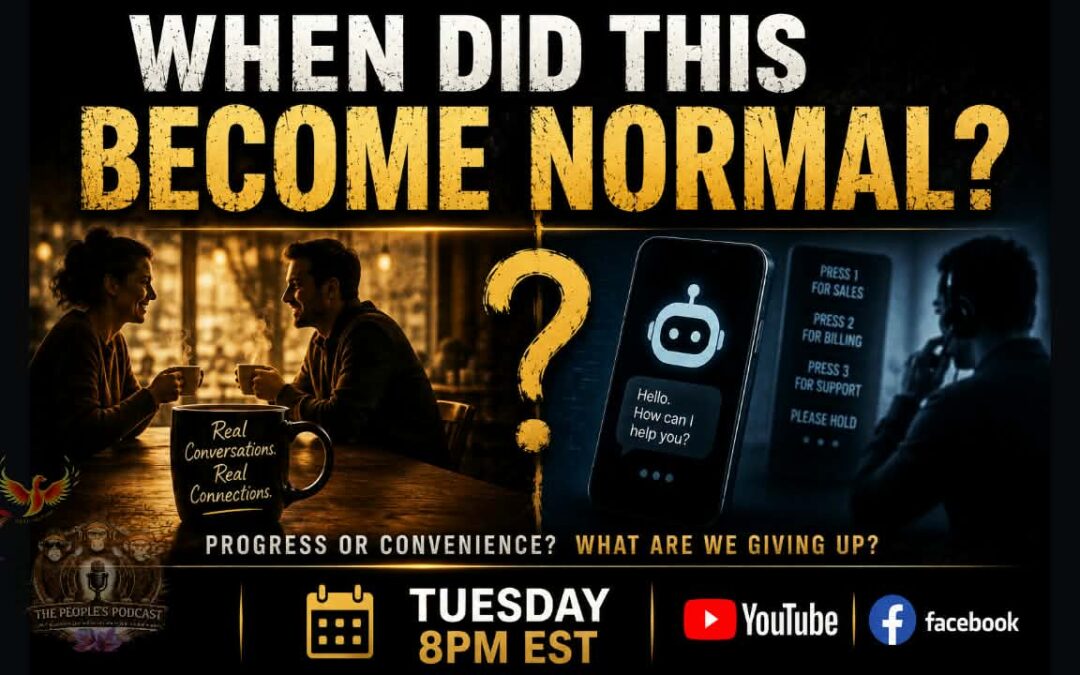
WHEN DID THIS BECOME NORMAL? Change rarely knocks on the door and announces itself.
Most of the time, it happens quietly.
One new machine.
One new fee.
One new subscription.
One less employee.
One more automated response.
One more convenience we accept because it is faster, easier, or simply the way things are done now.
Then one day, we look around and realize something that might have seemed strange twenty years ago has become completely ordinary.
And we have to ask:
When did this become normal?
THE PRICE OF CONVENIENCE
Convenience isn’t necessarily a bad thing.
Technology has made information more accessible. We can communicate across the world in seconds. We can work from home, attend school online, access entertainment instantly, order groceries without leaving the house, and carry more information in our phones than generations before us could have imagined.
There is value in progress.
The deeper question is whether we have become so accustomed to convenience that we’ve stopped asking what we’re exchanging for it.
Sometimes the cost isn’t measured in dollars.
Sometimes the cost is ownership.
Sometimes it is privacy.
Sometimes it is employment.
Sometimes it is patience.
And sometimes it is human connection.
When did this become normal?
Maybe it became normal so gradually that we never noticed the exchange taking place.
WHEN OWNERSHIP BECAME ACCESS
There was a time when we purchased something and actually owned it.
We bought VHS tapes, DVDs and CDs.
We purchased books and placed them on shelves.
We bought software once and continued using it.
We could lend something to a friend, pass it down to our children, sell it, collect it, or pull it off a shelf years later.
Today, much of our entertainment, information, software, and digital content exists through subscriptions.
We didn’t necessarily notice the transition because it happened gradually.
One service became a subscription.
Then another.
Then another.
A small monthly payment here.
Another monthly payment there.
Before long, we were spending money every month for access to things we may never actually own.
That raises an important question:
When did ownership become temporary access?
And perhaps more importantly, when did this become normal?
WHAT HAPPENS TO THE ORIGINAL?
Books deserve their own place in this conversation.
As more information becomes digitized, preserving physical books and original materials still matters.
Digital copies can make information easier to access, search, store, preserve and distribute. That has tremendous value.
Yet a physical object can carry something a digital file cannot completely reproduce.
The paper.
The printing.
The notes someone wrote in the margins.
The edition.
The illustrations.
The signs of age.
The history of the object itself.
There is something different about holding a book that existed decades—or even centuries—before you did.
Progress and preservation do not have to be enemies.
We should be able to embrace technology while still understanding the importance of protecting original knowledge, physical history and the objects that tell us where we came from.
Digitization can preserve information.
Preservation can protect the original.
There should be room for both.
Because once an original disappears, a digital copy cannot necessarily replace everything that disappeared with it.
WHEN WE BECAME THE EMPLOYEE
Remember when someone rang up your groceries and another person might have bagged them?
Today, many of us walk into stores, select our products, scan them ourselves, bag them ourselves, pay the company, collect the receipt and walk out.
Self-checkout was introduced as convenience.
And for many people, it absolutely is.
It’s quick.
Lines can be shorter.
Some customers prefer having less interaction.
There is another side worth discussing.
When businesses automate tasks once performed by employees, what happens to those jobs?
And when the customer begins performing part of the labor involved in the transaction, who benefits most from that convenience?
We have adapted so well that many younger people may never remember shopping any other way.
That’s what makes the question interesting.
We’re not simply asking whether self-checkout is good or bad.
We’re asking whether we noticed the exchange taking place.
At what point did doing the work ourselves become part of the shopping experience?
When did this become normal?
EVEN AIR CAN COME WITH A PRICE
There was a time when pulling into a gas station and putting air in your tires often meant finding a machine and filling your tires without thinking much about the cost.
Today, depending on where you stop, you may find yourself pulling out a card or searching for change just to inflate a tire.
Something as simple as air becomes another transaction.
Maybe that seems small.
That’s exactly why it belongs in this conversation.
Normalization doesn’t always begin with something enormous.
Sometimes it begins with the little things.
A dollar here.
A fee there.
A service that used to be included.
A convenience that suddenly has a price attached to it.
We shrug our shoulders and say:
“Well, I guess that’s just how it is now.”
And life moves on.
Until somebody stops long enough to ask:
When did this become normal?
PRESS 1. PRESS 2. PLEASE HOLD.
There was a time when calling a business usually meant eventually speaking with another person.
Today, we often encounter something very different.
Press 1 for sales.
Press 2 for billing.
Press 3 for customer service.
Enter your account number.
Repeat your request.
Say “yes” or press 1.
I’m sorry, I didn’t understand that.
Please try again.
Listen carefully because our menu options have changed.
And sometimes, after doing all of that, we still haven’t spoken to another human being.
Automation can make businesses more efficient. It can answer basic questions quickly and help companies handle enormous numbers of calls.
There are genuine benefits.
Yet efficiency feels very different when you’re frustrated, confused, grieving, elderly, struggling with technology, or dealing with a problem that doesn’t fit neatly into a menu option.
Life doesn’t always fit into “Press 1, 2 or 3.”
Sometimes people don’t need another prompt.
They need a person.
They need someone who can listen, understand the situation and respond to the human being on the other end of the phone.
WHEN THE COFFEE TABLE BECAME A SCREEN
This may be one of the most complicated parts of the conversation.
There was a time when we sat across from one another over coffee and talked.
We disagreed.
We laughed.
We told stories.
We watched facial expressions.
We heard changes in someone’s voice.
We noticed when someone’s eyes didn’t match their smile.
We sat through uncomfortable silence.
We learned one another through presence.
Today, technology can provide something that resembles parts of that experience.
Artificial intelligence can answer questions, help organize thoughts, explain difficult concepts, assist with writing, brainstorm ideas and participate in conversations that can feel meaningful.
That can be incredibly useful.
AI can help someone learn.
It can help someone create.
It can help a business owner accomplish something they couldn’t afford to hire someone else to do.
It can help us explore ideas we might not have considered before.
The concern isn’t that people use technology.
The deeper question is what happens if technology begins replacing the human relationships it was supposed to support.
There is something technology cannot duplicate completely:
Human presence.
Sitting across from someone.
Looking into their eyes.
Hearing the hesitation in their voice.
Sharing a cup of coffee.
Laughing at something neither of you expected.
Being quiet together without needing to fill the silence.
AI can be a powerful tool.
It should not make us forget the value of sitting across from another human being and saying:
“Talk to me. I’m listening.”
CONVENIENCE OR CONNECTION?
Maybe the real issue isn’t any single machine, subscription, fee, algorithm, artificial intelligence system or piece of technology.
Maybe the issue is how quickly human beings adapt.
We adapt because we have to.
Then adaptation becomes routine.
Routine becomes expectation.
Expectation becomes normal.
Eventually, an entire generation can grow up never knowing there was another way.
That doesn’t automatically mean the old way was better.
Not everything from the past needs to return.
Technology has solved real problems, increased accessibility, connected people across enormous distances and created opportunities that previous generations never had.
This conversation isn’t about romanticizing yesterday.
It’s about paying attention to today.
Remembering where we came from gives us the ability to consciously decide where we’re going.
We can appreciate progress and still question it.
We can enjoy convenience and still examine its cost.
We can embrace technology and still protect human connection.
Those things can exist together.
PROGRESS DOESN’T HAVE TO COST US OUR HUMANITY
We don’t have to reject technology to protect human connection.
We don’t have to abandon innovation to question its consequences.
We don’t have to fear progress to ask who benefits from it.
And we don’t have to return to the past to carry its lessons forward.
Perhaps the responsibility belongs to all of us.
Use the technology.
Enjoy the convenience.
Ask questions.
Protect what deserves preserving.
Have conversations with actual people.
Sit across the table from someone sometimes.
Support spaces where human interaction still matters.
Own what you can.
Pay attention to what you’re exchanging for convenience.
Notice when something that once seemed unusual quietly becomes expected.
Because progress should serve humanity.
Humanity shouldn’t disappear in the pursuit of progress.
THE CONVERSATION CONTINUES
“When Did This Become Normal?” isn’t a question with one answer.
That’s exactly why we’re asking it.
Join us on The People’s Podcast as The Twisted Team takes this conversation beyond the page.
We aren’t coming together to tell you what to think.
We’re asking all of us to think.
What have we gained?
What have we lost?
What has genuinely improved our lives?
What have we accepted simply because everyone else accepted it?
What conveniences are worth the exchange?
And what parts of being human are simply too valuable to trade away?
Progress deserves celebration.
It also deserves examination.
Maybe we don’t need to reject where the world is going.
Maybe we simply need to remain awake enough to notice how we’re getting there.
And every once in a while, when the world tells us something is simply the way things are now, we can still be willing to ask:
When did this become normal?
The People’s Podcast
Tuesday at 8 PM ET
Streaming on YouTube and Facebook
We’re the ears that listen, where your opinion matters.
Asè.