
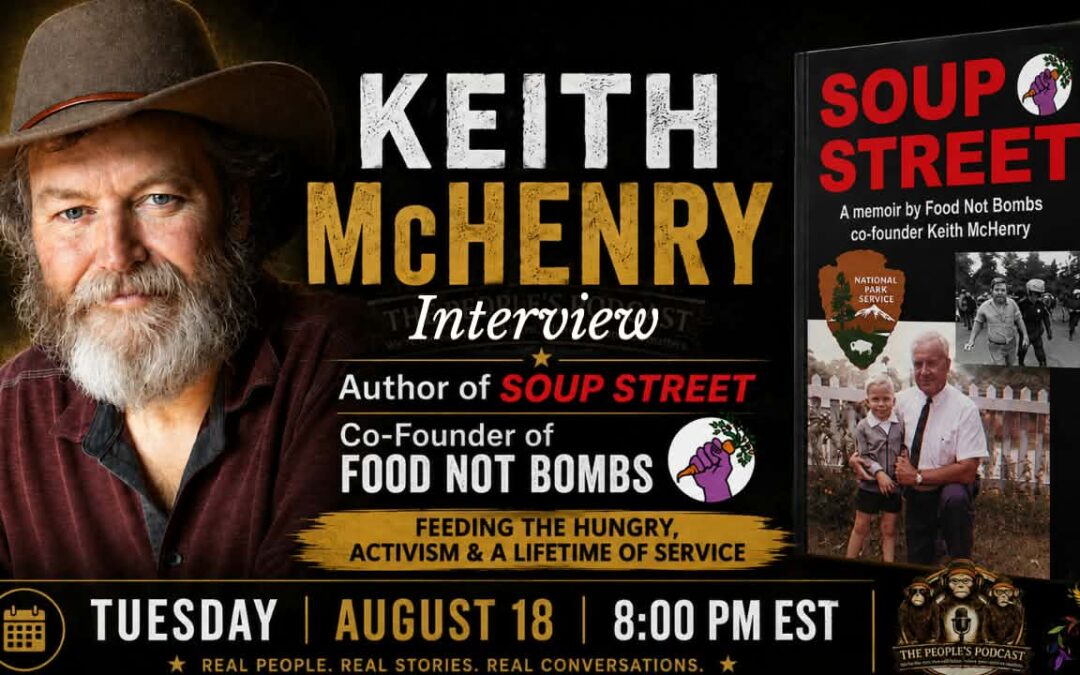
Food Not Bombs: Keith McHenry, What happens when something as simple as sharing a meal becomes a statement?
Food is one of our most basic human needs. We all need it. Hunger does not care about your age, your background, your education, your employment status, or how you arrived at the circumstances you are facing.
Yet every day, usable food is discarded while people in our communities go hungry.
For more than four decades, Keith McHenry, artist, author, activist, and co-founder of Food Not Bombs, has challenged us to look at that contradiction.
On Tuesday, August 18th at 8 PM EST, Keith McHenry joins The People’s Podcast for a conversation that goes beyond feeding people.
We’re talking about hunger, food waste, poverty, war, community, activism, and what can happen when ordinary people decide that seeing a problem is not enough.
FROM AN IDEA TO A MOVEMENT
Food Not Bombs began in Cambridge, Massachusetts in 1980 when Keith McHenry and seven other anti-nuclear activists came together following the arrest of a friend during an attempt to stop the Seabrook Nuclear Power Station.
What began with bake sales to help cover legal expenses developed into something much larger.
The group began recovering food that would otherwise be discarded and getting it into the hands of people who could use it. They prepared vegetarian meals, shared food in public spaces, and connected hunger to larger conversations surrounding poverty, war, spending, and social priorities.
The idea behind the name was simple enough to understand without a lengthy explanation:
Food Not Bombs.
More resources toward meeting human needs. Less toward destruction.
Decades later, that message continues.
FOOD THAT WOULD HAVE BEEN THROWN AWAY
One of the ideas behind Food Not Bombs forces us to confront an uncomfortable contradiction.
People are hungry.
Food is being thrown away.
Those two realities exist at the same time.
Food Not Bombs volunteers recover food that would otherwise be discarded and prepare free vegan and vegetarian meals that are shared with anyone without restriction.
There are no formal leaders controlling the movement. Local groups operate autonomously, make decisions through consensus, and organize around nonviolence and community participation.
It is not simply about handing someone a plate of food.
It asks us to examine why that plate was needed in the first place.
WHEN FEEDING PEOPLE BECOMES POLITICAL
Sharing food sounds like one of the least controversial things a person could do.
Someone is hungry.
Someone else has food.
You feed them.
Yet throughout the history of Food Not Bombs, volunteers have faced arrests and opposition for publicly sharing meals.
Keith himself has been arrested while participating in food-sharing actions.
That raises a question worth sitting with:
When did feeding someone who is hungry become an act of protest?
Maybe the controversy isn’t really about the food.
Maybe it comes from what the act of sharing it forces society to acknowledge.
If enough food exists to be discarded while people remain hungry, what does that say about the systems we’ve created?
If volunteers can recover that food and redistribute it, what does that tell us about scarcity?
And when communities begin meeting one another’s needs without waiting for someone else to solve the problem, what changes?
NOT CHARITY — COMMUNITY
Food Not Bombs describes itself as an all-volunteer movement dedicated to nonviolent social change rather than a traditional charity.
That distinction matters.
Charity can sometimes create a separation between the person giving and the person receiving.
Community asks something different.
It asks us to recognize one another.
Today I may have something you need.
Tomorrow you may have something I need.
Food becomes more than something placed on a plate. It becomes a way of bringing people together, creating conversation, and reminding us that another person’s struggle does not make them less human.
HUNGER IN A WORLD OF ABUNDANCE
We often talk about hunger as though there simply isn’t enough food.
Yet food waste tells another story.
That leaves us with bigger questions.
Is hunger always caused by a lack of food?
Or can hunger also exist because of how resources are distributed, who has access to them, what gets discarded, and what society chooses to prioritize?
Food Not Bombs has spent decades putting those questions directly into public spaces.
Not through theory alone.
Through meals.
MORE THAN FOUR DECADES OF SHOWING UP
A movement that began among eight young activists in Massachusetts grew far beyond its original community.
Food Not Bombs says its volunteers now share free vegan and vegetarian food in communities around the world while also providing food and supplies during disasters, strikes, occupations, marches, and other community actions.
There is something powerful about that longevity.
Movements change.
People change.
The world changes.
Yet hunger remains.
Food waste remains.
War remains.
Poverty remains.
And people continue showing up with food.
SOUP STREET: THE STORY BEHIND THE JOURNEY
Keith McHenry has now put his journey into his 2026 memoir, Soup Street.
Across 332 pages, Keith takes readers from childhood adventures in America’s National Parks through the experiences that shaped his activism, the founding of Food Not Bombs, and decades spent traveling the world preparing and sharing meals.
It is not simply the history of an organization.
It is the story of a life spent questioning what society accepts as normal and choosing to do something about it.
Learn more about Soup Street and purchase the book directly through Food Not Bombs:
https://foodnotbombs.net/soup_street.html
WHAT ARE WE REALLY HUNGRY FOR?
Maybe hunger isn’t the only thing this conversation is about.
Maybe we’re also hungry for community.
For connection.
For dignity.
For systems that place human needs somewhere near the top of the priority list.
For the belief that we do not have to walk past a problem simply because we didn’t create it.
Keith McHenry and Food Not Bombs remind us that change does not always begin with enormous institutions or unlimited resources.
Sometimes it begins with people noticing what is being wasted, recognizing who is being overlooked, and deciding to bring the two together.
One meal.
One community.
One act at a time.
JOIN THE CONVERSATION
On Tuesday, August 18th at 8 PM EST, join Universe Badger, Golden Eagle and The Twisted Team on The People’s Podcast as we sit down with Food Not Bombs co-founder Keith McHenry.
We’ll talk about the beginning of Food Not Bombs, his decades of activism, hunger and food waste, the resistance he has faced, his new memoir Soup Street, and what more than forty years of feeding people has taught him about humanity.
And as always, we aren’t here to tell you what to think.
We’re here to have the conversation.
Because maybe the question isn’t simply:
How do we feed the hungry?
Maybe we also need to ask:
Why, in a world with so much, are people still hungry?
Join us Tuesday, August 18th at 8 PM EST on The People’s Podcast.
Unseen Twisted Truths LLC on YouTube
Kimberly Vertigan on Linkedin
We’re the ears that listen, where your opinion matters.