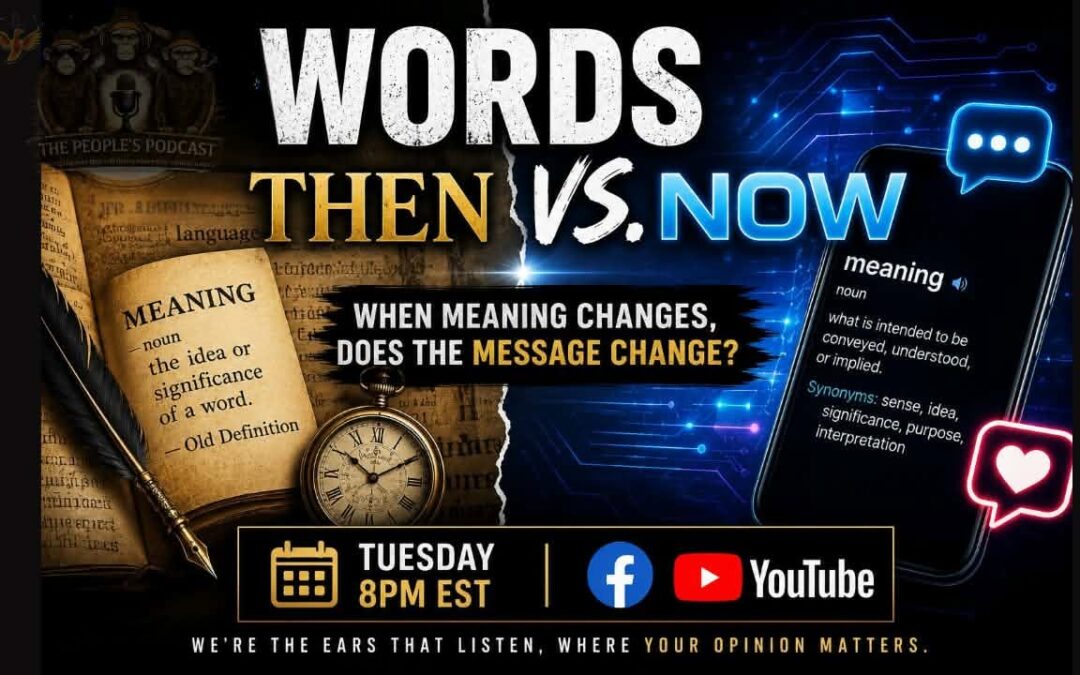
Then vs. Now: Language is one of humanity’s greatest tools. It allows us to share knowledge, express emotions, preserve history, inspire change, and connect with one another across generations. Yet language is not fixed. Words evolve. Definitions shift. Context changes. Entire generations can use the same word while intending completely different meanings.
Then vs. Now: This raises an important question:
When the meaning of a word changes, does the original message change?
Then vs. Now: History shows us that words have never remained completely static. New words emerge, older words disappear, and existing words often develop new meanings as society changes. Technology, culture, politics, religion, science, and social movements all influence the evolution of language. What one generation considered normal may sound foreign to the next.
Sometimes these changes improve communication by providing language that better reflects new discoveries and experiences. Other times they create confusion because people unknowingly use the same word while operating from completely different definitions.
Think about words like love, truth, freedom, justice, gender, trauma, faith, success, spirituality, family, or even respect. Each of these words can mean something entirely different depending on a person’s upbringing, experiences, education, culture, beliefs, and generation.
When definitions differ, conversations often become disagreements before understanding ever has a chance.
Many arguments aren’t necessarily about facts. They’re about language.
One person believes they’re defending one idea while another believes they’re arguing against something completely different—even though they’re using the exact same words.
Words also influence how we think.
If language shapes perception, then changing language can influence how future generations understand history, science, relationships, morality, and even themselves. This doesn’t automatically mean change is good or bad. It simply means language has tremendous power, and understanding that power helps us become better communicators.
This conversation isn’t about deciding whose definition is right.
It’s about recognizing that understanding begins by asking what someone actually means rather than assuming they mean what we mean.
Communication is more than speaking.
Communication is understanding.
Perhaps one of the greatest skills we can develop is learning to pause before reacting, asking questions before making assumptions, and becoming curious enough to understand another person’s perspective before forming conclusions.
Words build bridges.
Words also build walls.
The difference often comes down to whether we’re listening to understand or listening only to respond.
Join us this Tuesday as we explore how language has evolved over time, how changing definitions shape communication, and whether changing the meaning of words changes the message itself.
This promises to be a thought-provoking discussion that challenges perspectives while encouraging understanding.
Join the Conversation Live
Then vs. Now:
📅 Tuesday
🕗 8:00 PM EST
📺 Watch on YouTube
https://www.youtube.com/@UnseenTwistedTruths
📘 Watch on Facebook
https://www.facebook.com/UnseenTwistedTruths
🌐 Visit Our Website
https://unseentwistedtruths.com
We’re the ears that listen, where your opinion matters. Let’s Have A Good Conversation.