
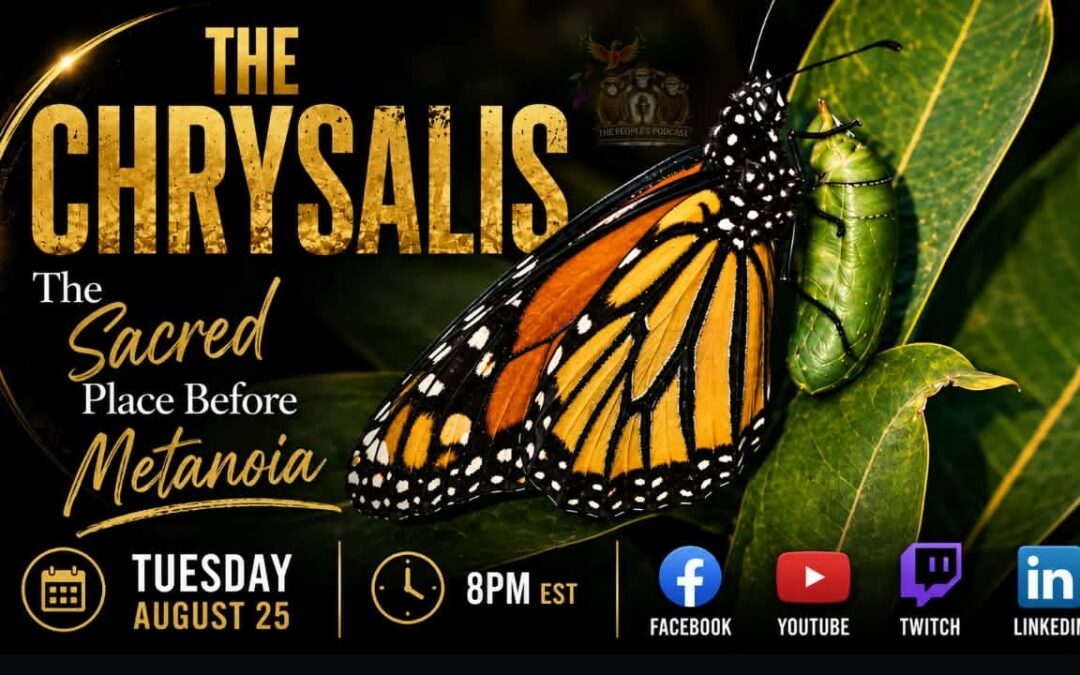
Everyone talks about the Metanoia, yet few conversations acknowledge how sacred the Chrysalis can be.
Transformation tends to receive attention once there is something visible to celebrate. A person finds their voice, breaks a cycle, discovers a purpose, leaves something behind, begins again, or finally becomes comfortable with who they are. From the outside, we see the breakthrough and recognize the awakening because there is evidence that something changed.
What we don’t always see is what happened before the transformation became visible.
There is a period when the person you have always known yourself to be begins fading, while the person you’re becoming hasn’t fully taken shape. Life can feel unfamiliar during that transition, even when nothing around you has dramatically changed.
That space in between is the Chrysalis.
The Chrysalis: When Your Old Life No Longer Fits
Growth doesn’t always begin with a dramatic ending. It can arrive quietly through the realization that something familiar no longer feels right.
A relationship may still exist while your connection to it changes. Conversations that once held your attention can begin feeling distant. Long-held beliefs may create questions instead of certainty, and roles you’ve occupied within your family, friendships, or career may no longer reflect the person developing underneath them.
Recognizing that you’ve outgrown something doesn’t automatically provide instructions for what comes next. That’s part of what makes this stage uncomfortable as hell.
Familiar identities provide certainty. Even an identity we’ve outgrown can feel safer than standing without a definition at all. Reaching backward becomes tempting because at least we recognize the person who lived there.
The Chrysalis exists within that uncertainty. It allows an old identity to loosen before demanding that a new one immediately replace it. Rather than being evidence that you’re lost, the absence of a clear definition may simply mean you’re experiencing yourself without relying on the labels that once explained who you were.
There is something sacred about allowing that process to unfold without forcing an answer.
Solitude Isn’t Always Loneliness
Change can naturally create distance from environments that once felt comfortable. This isn’t necessarily rejection, isolation, or a loss of love for the people around us. At times, quiet becomes necessary simply because it’s difficult to recognize your own voice while surrounded by everyone else’s.
Expectations accumulate over a lifetime. Family, relationships, culture, responsibilities, survival, and even love can influence the person we learn to become. Eventually, separating genuine desire from obligation requires enough space to hear the difference.
Solitude offers that space.
Without constant outside input, previously unnoticed questions begin surfacing. Beliefs can be examined rather than automatically repeated. Interests become easier to recognize when they aren’t competing with someone else’s needs, and decisions begin reflecting internal alignment rather than external approval.
Loneliness and solitude can feel similar on the surface, although they don’t always serve the same purpose. One can leave us longing for connection; the other can create an opportunity for re-connection with ourselves.
The quiet of the Chrysalis isn’t necessarily empty. It may be the first environment where your own voice has enough room to become clear.
Growth Isn’t Always Beautiful While It’s Happening
Transformation has been romanticized because we usually encounter it after the difficult part has passed. The butterfly is beautiful. What happened inside the Chrysalis is far less picturesque.
Real growth can involve confusion, grief, changing beliefs, shifting relationships, and uncomfortable realizations about things once defended as normal. Happiness may begin coming from different places. Certain conversations lose their appeal, boundaries develop where none existed before, and familiar reactions no longer feel appropriate.
From the outside, very little may appear to be happening. Internally, an entire understanding of self can be reorganizing.
This is why growth isn’t always recognizable while we’re living through it. We expect transformation to arrive with certainty, confidence, and some unmistakable indication that we’ve reached another level. Often the deepest shifts begin long before we have language for them.
Quiet change is still change.
When Discomfort Becomes Information
Comfort maintains what already exists. Growth asks something different of us.
That doesn’t mean pain or suffering must take place for growth. Real change often brings uncertainty, unfamiliarity, vulnerability, and discomfort because we’re thinking, responding, and choosing differently than we have before.Comfort is easy to confuse with health because familiarity feels predictable. A pattern can hurt us and still feel safer than changing it simply because we know what to expect from it.
That distinction becomes important inside the Chrysalis.
Responding differently to an old trigger can initially feel unnatural. Walking away from an argument instead of participating in it may create more discomfort than arguing ever did. Allowing a relationship to end rather than chasing after it can feel foreign. A simple no may feel incomplete after years of explaining every boundary, while taking up space can feel selfish after a lifetime of making yourself smaller for everyone else.
None of those feelings automatically mean the new behavior is wrong.
Discomfort carries information. At times it warns us of genuine danger or misalignment. In other moments, it reveals that we’re entering unfamiliar territory without the old patterns that once helped us navigate it.
Learning to distinguish between those experiences is part of transformation. The question becomes less about escaping every uncomfortable feeling and more about understanding what that feeling is trying to communicate.
Inside the Chrysalis, discomfort isn’t there to force the old you out. It’s part of what molds the person you’re becoming.
Grieving the Person Who Got You Here
Growth carries another experience that receives far less attention: grief for the person we used to be.
Looking backward can make previous choices seem obvious. With today’s awareness, we may wonder why we stayed, tolerated, believed, accepted, or remained silent. It’s easy to judge an earlier version of ourselves using knowledge that person hadn’t acquired yet.
That judgment overlooks something important.
The person you were made choices based on what you knew, what you had experienced, and what you were capable of handling at that time. You didn’t have today’s understanding then because much of that understanding came from living through the very experiences you now see differently.
Today’s wisdom was built partly through yesterday’s experiences.
Honoring an earlier version of yourself doesn’t mean returning to that identity or agreeing with every choice you made. It means recognizing that version as part of the journey that brought you here rather than someone you need to erase or be ashamed of.
Even the caterpillar doesn’t simply disappear inside the Chrysalis. Parts of its old form break down, other parts remain, and something new develops from what is already there. Human transformation can carry a similar truth. Growth doesn’t require destroying everything we used to be. Certain pieces are released, others come forward with us, and what we’ve lived through can become part of the foundation for who we’re becoming.
That’s where grief and gratitude can exist together. An identity may have been necessary for one season without being capable of carrying us into the next. There is tenderness in recognizing that an earlier version of yourself got you through places they were never meant to live forever.
Release doesn’t require hatred.
Sometimes it begins with understanding.
the Chrysalis IS The Sacred Space Before Metanoia
Metanoia describes a profound shift in mind, understanding, heart, or way of being. By the time such a transformation becomes recognizable, an internal process has often been unfolding for much longer than anyone realizes.
Assumptions begin turning into questions. Beliefs inherited from family, culture, relationships, or past experiences receive closer examination. Habits lose their usefulness, expectations loosen, and endings can take place internally long before they become visible externally.
This period may contain more uncertainty than answers, which makes it tempting to label it as confusion.
Perhaps it isn’t confusion at all.
An empty space appears when something old has been removed before something new arrives. We often rush to fill that opening because uncertainty makes us uncomfortable. The Chrysalis asks something different of us: remain there long enough to discover what actually belongs.
That process can reveal the difference between personal beliefs and inherited ones, authentic desires and expectations, or identity and survival.
Metanoia may describe the transformation we eventually recognize.
The Chrysalis is where much of that transformation quietly takes place.
Finding Beauty Without Rushing the Emergence
Modern life doesn’t have much patience for becoming. Progress is expected to be visible, measurable, and preferably accompanied by a plan.
After an ending, people ask what’s next. During uncertainty, they want an answer. Rest can be mistaken for stagnation, while taking time to understand a major shift may look like indecision from the outside.
Nature operates differently.
A seed doesn’t need to prove that something is happening beneath the soil. A Chrysalis doesn’t become less productive because its transformation is hidden from view. Neither process requires an audience to validate its progress.
Human transformation deserves some of that same grace.
There are seasons when outward action matters and others when internal restructuring requires more attention. Stillness can contain tremendous movement when beliefs are changing, identities are being released, and a different relationship with self is beginning to form.
“I don’t know yet” can be an honest answer rather than a failure to have direction.
Emergence doesn’t become more meaningful because it happened quickly.
Honor the Chrysalis
If you find yourself somewhere between who you were and who you’re becoming, there may be nothing to fix about that space.
Instead of rushing toward another identity, allow yourself to notice what is changing. Listen closely enough to recognize what no longer feels aligned and remain curious about what continues drawing you forward. Rest can exist alongside progress, just as uncertainty can exist alongside growth.
Transformation doesn’t require immediate explanation, and becoming someone new doesn’t create an obligation to introduce that person to the world before you’re ready.
Everyone talks about Metanoia because transformation is easier to recognize once it has a name.
The Chrysalis deserves recognition too.
It holds the uncertainty between identities, the solitude that makes room for self-discovery, the discomfort of unfamiliar choices, the grief of releasing an earlier version of ourselves, and the invisible work taking place long before anyone else notices a difference.
The Chrysalis isn’t a waiting room before transformation.
It is part of the transformation.
Tuesday, August 25th at 8 PM EST, we’re continuing this conversation on The People’s Podcast with The Chrysalis — The Sacred Place Before Metanoia.
Bring your story, perspective, and opinion to the conversation.
Let’s have a good conversation.
We’re the ears that listen, where your opinion matters.
Asè.